hpdz.net

High-Precision Deep Zoom

Still Images

Convergent Fractals

This page demonstrates some convergent fractals and fractals that are mixed convergent and divergent. Like the Mandelbrot set, these fractals are based on iterating a function in the form z=f(z), but in this case, the iterations cause z to converge to a finite value, like 1 or the square root of 2, rather than growing infinitely large.

The Convergent Fractals page in the Technical section has some basic information on the mathematical difference between convergent and divergent fractals, and an explanation of why they're really not different at all.

Newton's Method
Newton Fractal

Newton's method applied to x3-1=0. This is a classic image, one of the first fractals ever made back in the early days of fractal exploration.

Newton Fractal

Zooming in to the center, we see the theme that is repeated infinitely throughout this fractal.

Newton Fractal

Zooming in again. Can you tell how deep? This is all you will ever see in this thing, no matter where you look or how much you magnify.

Newton Fractal

Each point in the plane converges to one of the three solutions to z3-1=0. Here I have made the classic red-green-blue rendering showing which root each point goes to. Getting my program to do this was a hassle, but now I have the ability to create very intricate colorings with combinations of different palettes.

Newton Fractal

Newtons' method applied to sin(z)=0 in the complex number plane. This view extends horizontally a little more than -5pi/2 to +5pi/2.

Newton Fractal

The sine function again. No matter where you look this is all you will ever see, possibly with some asymmetry between the sizes of the loops.

Newton Fractal
Newton Fractal

Newton's method applied to x10=0, zoomed in a little. These were rendered with a very nice smoothing formula by David Makin. The top one uses his formula unaltered; the bottom one includes an exponential smoothing step.

Halley's Method
Halley Fractal

Halley's method for x3-1=0. Note that the more efficient root-finding method gives a less interesting fractal.

Halley FractalAs with the Newton fractal, this is a Julia set type of rendering and will look exactly the same no matter where or how much you zoom in.
Nova Fractal
Nova Cubic Fractal
Nova Bug Fractal
Nova Cubic Fractal

Nova Fractal for x3-1=0. This is a very old fractal. Maybe I'll find something new here?

The top two images show the fractal with the "standard" values of the initial value z0=(1,0) and the relaxation parameter r=(1,0). Two different coloring methods are demonstrated, although the same actual sequence of colors occurs in both.

The bottom image shows what happens to the standard Nova fractal as z0 approaches 0 (for z0=0 the Nova fractal is blank). Compare this to the Nova Bug image below. This is how I first noticed I had a tiny math error in my Nova code.

Nova Cubic Fractal

Nova Bug -- this is due to a bug in my first attempt at writing the code for a Nova fractal. The result is nearly identical to the true Nova fractal except in a small range of parameters. In particular, the bug gave something totally different for z0=0, which inspired me to tweak the original Nova equation to give the result above.

Modified Nova Cubic Fractal

Modified Nova Fractal at z0=0. This has the modification described in the NovaBug image. It gives something totally different and quite nice when z0=0.

The Bat Fractal
Bat Fractal
Bat Fractal

The Bat Fractal is a coding bug from my first attempt at Newton's method for z3-1=0.

When rendered with no smoothing (top image) it kind of looks like a bat.

The bottom image is the same coordinates but with exponential smoothing.

Bat Fractal Bat Fractal

The top image is a slightly magnified view of the central convergence at z=0.

The bottom image is zooming in a little more in the top part.

Bat Fractal
Bat Fractal

This fountain-spray sort of pattern is what we see when we zoom in. As with most Julia set fractals, there isn't much diversity of structure here.

This fractal, like the Henon map, quickly reduces to a dust of points on magnification.

These two images are exactly the same except for a slight change in the way the fractal data is converted to colors. This is one of the few fractals I've come across that renders well with a simple linear map.

Bat Fractal

This is zooming into a convergence at the top.

Bat Fractal

Here's a slightly more complex structure, but the basic motif is exactly the same.

Mixed Convergent/Divergent Fractals

It turns out that some fractals can have both divergent and convergent behavior. I have finally added the necessary infrastructure into my software to be able to handle this, and I'm really excited about the possibilities.

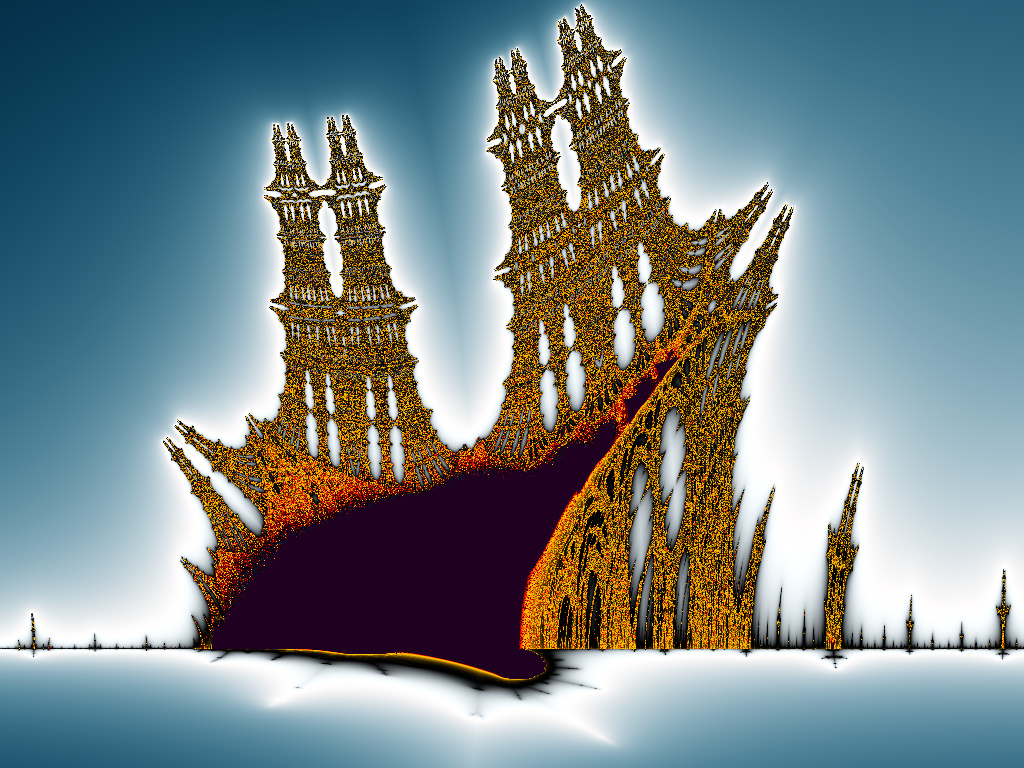
The "Magnet" fractals are two classic examples of this kind of fractal.  They comes from some equations that arise in a particular theoretical physics model of phase transitions in magnetic materials. The details of where the equation came from don't matter for the purpose of making fractal images. These fractals deserve a whole page explaining them, which I will write later.

Mixed Convergent/Divergent Fractals
Magnet Fractal Type 1 Magnet Fractal Type 1 Magnet Fractal Type 1

The Magnet Fractal, type 1.

In some areas, this fractal looks a lot like the Mandelbrot fractal formula z=z2+c, so we see tiny Mandelbrot sets scattered around within it.

It is not strictly self-similar like the Julia set kind of fractals that come from Newton's method and its relatives, so the structure of the local neighborhood persists and gives rise to complex structures like the Mandelbrot set does.

Magnet Fractal Type 2 Magnet Fractal Type 2

Magnet Fractal, type 2. The equation governing this fractal comes from a more complicated model of magnetic phase transitions than the type 1 fractal.

Just like the type 1 Magnet fractal, this one has little Mandelbrot sets and a complex non-scale-invariant structure that is promising for zooming.

Secant Method

The secant method is an iterative technique for solving equations that is very similar to Newton's method. For details, see the Technical page on this. Basically, it is a more primitive, less powerful way of performing the same operation that Newton's method does. That may sound undesirable, and when used for its intended purpose (solving equations) it is. However, the less powerful method makes much more interesting pictures. 

Secant Method
Secant Cubic Fractal

One of many possible ways of approaching the solution to z3-1=0 with the secant method. This initializes the first guess to 0 and the second guess to the image point. The image is centered at (0,0) and spans a height of 11 vertically in the complex number plane (44/3 horizontally).

Secant Cubic Fractal

This is the center of the previous image magnified.

The top image shows the unaltered iteration count data. Counts are obviously integers, so this image has flat bands. The middle iimage is the same as the top but has exponential smoothing applied.

The bottom image shows a magnified portion of this fractal. As with most fractals in this large group, the pattern repeats infinitely many times as we magnify the fractal more and more. Still, this is a very nice formula.

Secant Cubic Fractal Secant Cubic Fractal Secant Cubic Fractal Secant Cubic Fractal

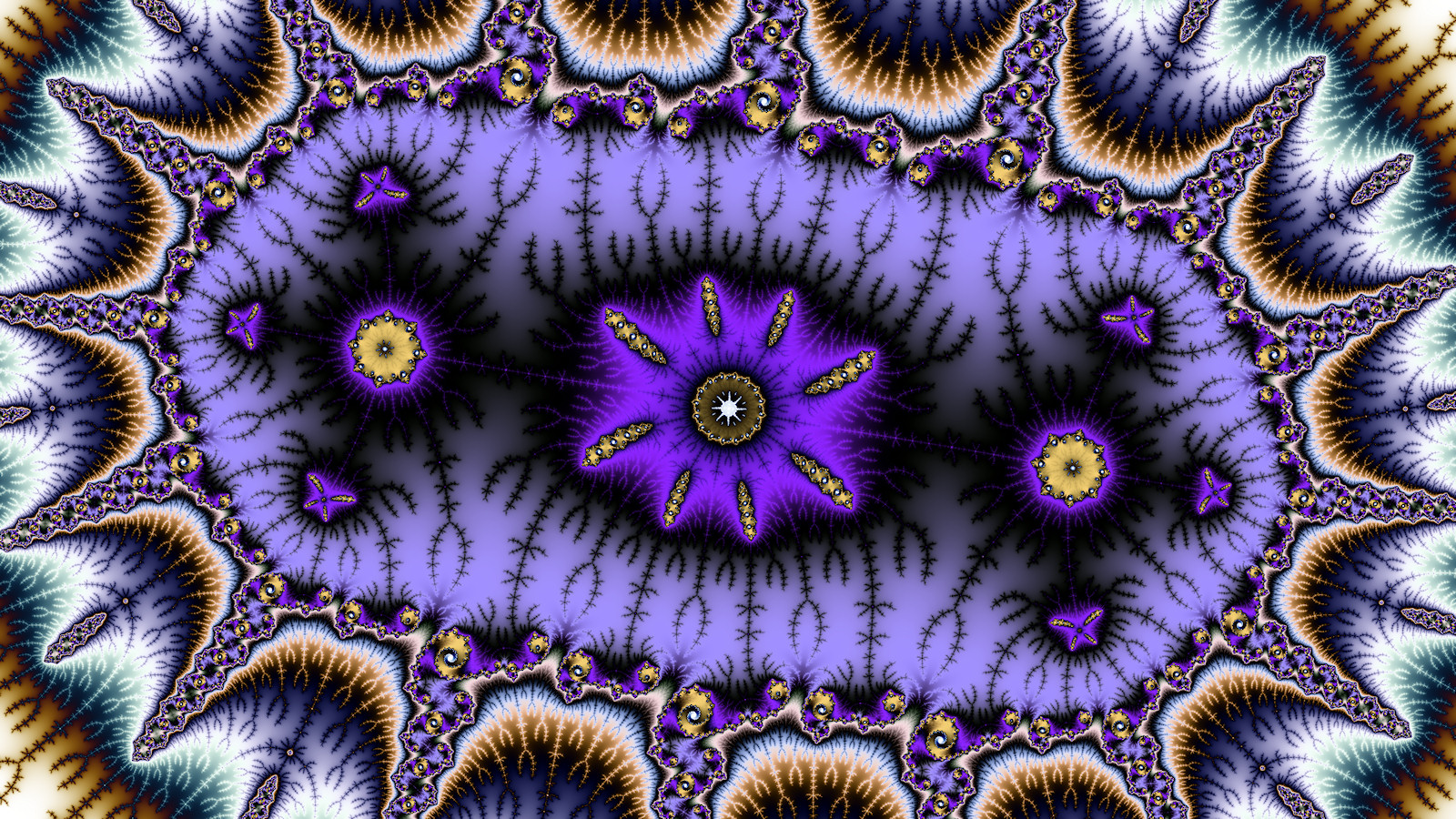
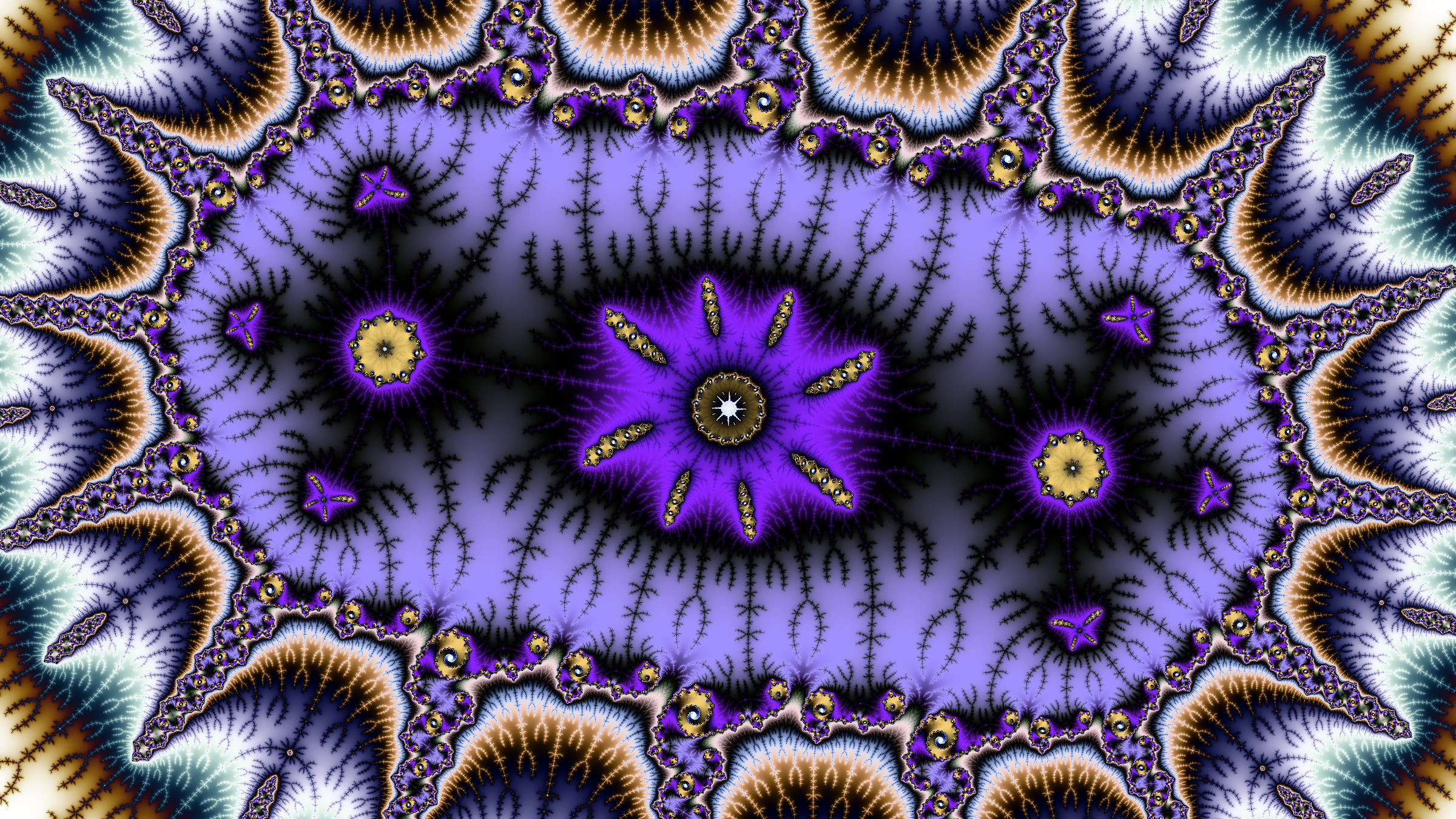
Here we apply the secant method to the cosine function.

The top image shows an overview of this amazingly complex fractal. It is centered at (0,0), and each of the points surrounded by a violet ring is a multiple of 2 pi. If you look very closely you will notice that they are all different, unlike most fractals in this family. This means there is great potential for deep zooming.

The second image is a magnification to a size of 1 vertically.

The third and fourth images are progressively deeper zooms off to the side, around -12 pi. Note in the third image that all the detail is different in each period. Look at how complex this thing is! Exploring all this is going to be a lot of fun.